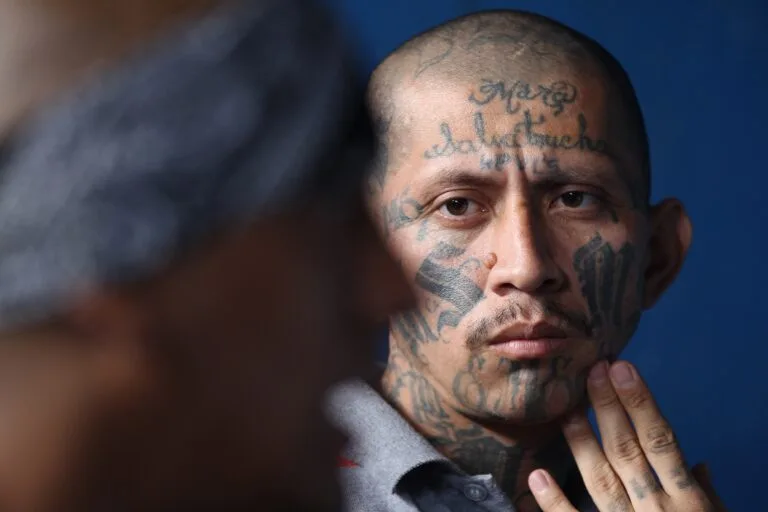
This program contains graphic imagery. Viewer discretion is advised.
NARRATOR:
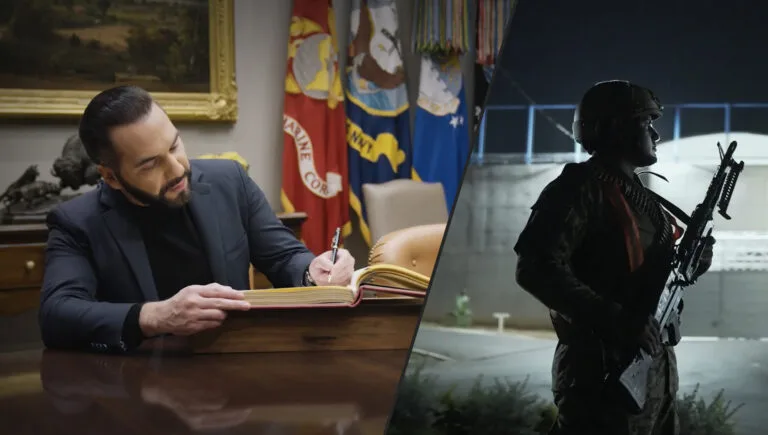
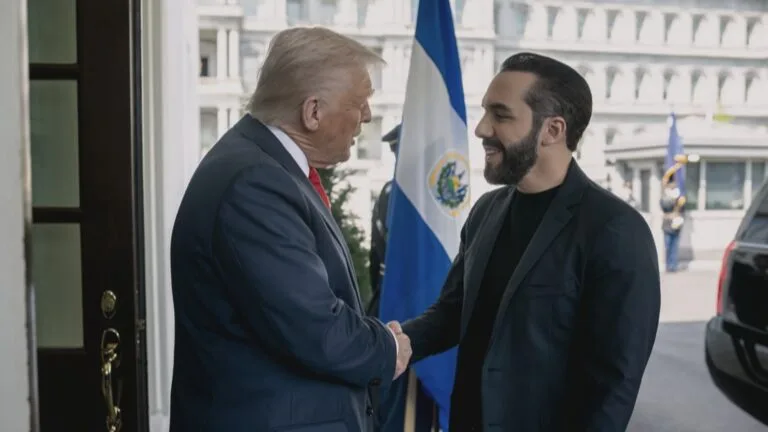
It was three months since President Donald Trump had returned to office and begun his major immigration crackdown. At the White House, the mood was celebratory as he welcomed the leader of El Salvador, Nayib Bukele.
PRESIDENT DONALD TRUMP:
We appreciate working with you because you want to stop crime, and so do we, and it’s very, very effective. And I want to just say hello to the people of El Salvador and say they have one hell of a president.
NARRATOR:
Bukele, who’d once called himself the world’s coolest dictator, had become a key player for Trump.
NAYIB BUKELE, President, El Salvador:
And we actually turned the murder capital of the world—that was what the journalists call it—
DONALD TRUMP:
Right.
NAYIB BUKELE:
—murder capital of the world into the safest country in the Western hemisphere. Sometimes they say that we imprison thousands. I like to say that we actually liberated millions.
DONALD TRUMP:
It’s very good. [Laughter] Who gave him that line? Do you think I can use that?
NARRATOR:
Bukele was giving President Trump much more than a punchline.
He’d opened the doors of El Salvador’s notorious prison, known as CECOT, for planeloads of deportees that the Trump administration had swept up and accused of being gang members.
FEMALE NEWSREADER:
CECOT is the largest prison in the Americas and is infamous for its harsh conditions.
MALE NEWSREADER:
The Trump administration deported more than 200 Venezuelan migrants from the U.S. to El Salvador, placed in a notorious high-security prison.
NARRATOR:
Despite revelations most of the men had no criminal convictions in the U.S. or proven gang affiliations, and concerns about harsh treatment, both presidents touted it as a win.
T. CHRISTIAN MILLER, ProPublica:
It was pretty obvious what Trump was getting out of this deal. It was much less obvious what Bukele was doing.
NARRATOR:
Over the past year, FRONTLINE and reporters from the El Salvador news outlet El Faro have been investigating what was behind the controversial deal—
CARLOS MARTÍNEZ, El Faro:
[Speaking Spanish] The nature of Bukele’s government is to keep things secret.
NARRATOR:
—and what Bukele stood to gain.
CARLOS DADA, Editor in Chief, El Faro:
All you know about him is his propaganda. The truth is quite different from what he says.
MALE VOICE:
[Speaking Spanish] Do you recognize the masked man in this picture?
ÓSCAR MARTÍNEZ, El Faro:
[Speaking Spanish] Bukele wants us jailed for revealing something that upset him.
NAYIB BUKELE:
[Speaking Spanish] You know what? I don’t care if they call me a dictator. I’d rather be called a dictator than see Salvadorans killed in the streets.
ÓSCAR MARTÍNEZ:
[Speaking Spanish] Bukele has long declared us, El Faro journalists, as his enemies. But the truth is, Bukele is trying to cover up his past. He needs the U.S. to help cover it up. And we haven’t finished telling that story yet.
New York
September 25, 2019
NARRATOR:
The roots of the deal between Presidents Trump and Bukele trace back to their first meeting.
NARRATOR:
The two leaders were in New York for the United Nations General Assembly.
NARRATOR:
Bukele was promising to help Trump with one of his signature issues: stemming the flow of immigrants into the U.S.
KATE LINTHICUM, Los Angeles Times:
Bukele decides he is going to take responsibility for the issue of migration from El Salvador.
DONALD TRUMP:
It’s a great honor to be with the president of El Salvador.
KATE LINTHICUM:
And that’s around the time where you start seeing Bukele coming into Trump’s orbit and connections forming between the Bukele team and Trump’s world.
NARRATOR:
The American president was also particularly impressed with the way Bukele was cracking down on El Salvador’s notoriously violent gangs.
DONALD TRUMP:
The president has done an incredible job with MS-13. He realizes what a threat they are, and they have been very, very tough.
KATE LINTHICUM:
Both just have this irreverence that I think appeals to people who see them as not the average politician. And I think both respect, at the end of the day, more than anything, power. And so when they see others who have it, they respect that.
NAYIB BUKELE:
We’re very happy to be here, and we’re hoping that this meeting will only strengthen our relationship even more. And I think it will, because, you know, we’re—President Trump is very nice and cool, and I’m nice and cool, too. [Laughter]
DONALD TRUMP:
Thank you very much.
NARRATOR:
Bukele was emerging as one of Latin America’s most popular leaders, building his reputation on being extremely tough on gangs.
CARLOS MARTÍNEZ, El Faro:
[Speaking Spanish] El Salvador has never been a peaceful country. Since I started practicing journalism, El Salvador has always been violent.
NARRATOR:
Carlos Martínez is a reporter at El Salvador’s premier investigative news outlet, El Faro.
He and his brother, Oscar, have been reporting on Bukele and the country’s gang problems for years.
ÓSCAR MARTÍNEZ:
[Speaking Spanish] I had never seen anything like what happened in 2015. It was worse than an open war. The streets were filled with corpses. The morgues in El Salvador couldn’t keep up.
NARRATOR:
At the peak of the violence in 2015, El Salvador had the highest murder rate in the world. The brutal MS-13 gang was battling its rival, Barrio 18.
MALE NEWSREADER:
One of the most dangerous countries on earth, a place where criminal gangs control entire neighborhoods.
NARRATOR:
Bukele had just become mayor of the capital, San Salvador, the epicenter of the violence.
CARLOS MARTÍNEZ:
[Speaking Spanish] When Bukele took office as mayor of the capital, the country was probably going through one of the most violent periods in its history. And that’s no small claim in a country like El Salvador.
NARRATOR:
At first, Bukele’s approach to the violence was less confrontational, promoting social services and community building.
CARLOS DADA, Editor in Chief, El Faro:
His political discourse was that we needed to have long-term solutions for those communities taken over by gangs to have another kind of life, where kids would have more options that just be part of a gang or be killed. In almost every single issue, he was very progressive.
We organize every year a Central American Journalism Conference. When he was a mayor of San Salvador we invited him. He came. That talk in which he spoke was moderated by Carlos Martínez, one of our reporters.
NAYIB BUKELE:
[Speaking Spanish] I believe what we have in El Salvador is a broken social fabric … And what we must do now is rebuild the social fabric, give these young people opportunities and ensure violence is not solved with more violence …
NARRATOR:
He focused on revitalizing the city center.
NAYIB BUKELE:
[Speaking Spanish] Today we conclude the full revitalization of the heart of San Salvador’s historic center.
NARRATOR:
Crime and violence there dropped. Bukele’s popularity rose.
NAYIB BUKELE:
[Speaking Spanish] May God bless you all. And may God bless our dear country, El Salvador. Thank you very much.
NARRATOR:
And in 2019, after just one term as mayor, he ran for president.
CARLOS MARTÍNEZ:
[Speaking Spanish] The first thing Bukele does is to present himself as an outsider, someone who would break with that corrupt past that had shaped democracy in El Salvador since the civil war. And it was a message that Salvadorans were desperate to hear. And from that idea, Bukele crafted his image as “The Avenger.” And he managed to convey this message in a very powerful way, and people ate it up. He got more votes than the rest of the parties combined.
MALE SPEAKER:
[Speaking Spanish] Citizen Nayib Armando Bukele Ortez … you are hereby sworn in as the president of the Republic of El Salvador.
ÓSCAR MARTÍNEZ:
[Speaking Spanish] People voted for Bukele in 2019 because they were fed up with the other electoral choices. You had to be crazy to keep voting for those political parties. Not only had they made us one of the most murderous countries on the planet, but they had stolen everything they could.
NARRATOR:
Within weeks of taking office, Bukele made a dramatic announcement.
NAYIB BUKELE:
[Speaking Spanish] The plan was presented yesterday and it’s a comprehensive plan … There are elements that obviously cannot be revealed … We are going to enforce the law where the state must be present … We’re going to control the areas that generate the most money for the gangs …
NARRATOR:
He was now promoting a tougher approach. He vowed he wouldn’t compromise or negotiate with the gangs.
NAYIB BUKELE:
[Speaking Spanish] I have not received any communication from MS-13 seeking dialogue, and we are not willing to talk with criminal groups either.
KATE LINTHICUM:
Bukele vowed to be different than the leaders who had ruled El Salvador for decades, the leaders who had been convicted in bribery cases, who had committed graft and who had been shown to actually be negotiating with the leaders of the powerful street gangs that ruled much of El Salvador.
He declares that he is going to tackle crime and fight the gangs with this new plan, the Plan Control Territorial.
The details of this plan are very opaque. But what we know is that he’s deploying more police and soldiers around the country. The country does start to get safer.
NARRATOR:
In the first months of Bukele’s Territorial Control Plan, over 5,000 people were arrested; the murder rate hit historic lows.
To the reporters at El Faro, these results seemed too good to be true.
CARLOS DADA:
We knew that there was something strange going on. You can’t become a president and the next day reduce so dramatically the homicide rates without something tricky going on.
NARRATOR:
As the El Faro reporters started investigating, another investigation was taking place that would eventually help shed light on what was behind Bukele’s crackdown. In the U.S., federal authorities were fighting their own campaign against MS-13, which had taken root in many American cities.
FEMALE NEWSREADER:
MS-13, the notorious street gang responsible for the wave of violence that has terrorized this community.
TUCKER CARLSON:
MS-13 is an international crime cartel, that’s not an overstatement. It’s based in El Salvador. It has rapidly become one of America’s largest and deadliest street gangs.
DANIEL BRUNNER, Former Special Agent, FBI:
My name is Daniel Brunner, and I was a special agent for the Federal Bureau of Investigations. My responsibility was MS-13 cases in the state of New Jersey.
MS-13 is one of the most extraordinarily violent gangs that’s out there.
I’ve seen some horrible crime scenes in my years. You had a quadruple homicide in Long Island. You have homicides in New Jersey, in Virginia, Maryland.
FEMALE NEWSREADER:
This is now the 10th murder here in Nassau County since 2016 due to the gang MS-13.
NARRATOR:
As in El Salvador, the U.S. had a tough-talking president.
DONALD TRUMP:
It is the policy of this administration to dismantle, decimate and eradicate MS-13. … One by one we’re liberating our American towns.
DANIEL BRUNNER:
I got a call in 2019. This U.S. attorney said, “Hey, would you be interested in joining this new task force that we’re putting together that is going to be taking out MS-13 from the top down?”
Task Force Vulcan was created by Attorney General Barr under the direction of President Trump.
WILLIAM BARR, U.S. Attorney General:
What we’ve been in here discussing with the president is Project Vulcan or Task Force Vulcan … targeting the higher-level players in the MS-13 operations.
DONALD TRUMP:
This is probably the meanest, worst gang anywhere in the world, the MS-13 group. They’re sick, they’re deranged and we’re taking care of it.
NARRATOR:
MS-13 members in America, they said, were receiving orders from the gang leadership in El Salvador, many of whom had been thrown in prison there.
DANIEL BRUNNER:
Taking out the leadership in El Salvador and bringing them to United States changes the entire dynamic of the organization. There’s leaders on the streets and then there’s leaders in jail. We wanted them both.
DONALD TRUMP:
Thank you very much.
DANIEL BRUNNER:
Our goal was to get them out of those jails into U.S. jails, cutting the head off the snake.
NARRATOR:
Over the next year, Brunner and other agents worked with investigators in El Salvador to build cases to extradite the jailed MS-13 leaders. It became a far-reaching effort.
DANIEL BRUNNER:
The team was put together to be able to look at all MS-13 criminal activity, including political corruption, including their influence in government activities.
NARRATOR:
Task Force Vulcan’s investigation would soon intersect with El Faro’s reporting.
CARLOS MARTÍNEZ:
[Speaking Spanish] I met the Vulcan agents who were involved in the crackdown on gangs in El Salvador. And they were very interested in my knowledge of the gang phenomenon and in the experience I had researching it. And as time went by, we talked with various sources. And inside the U.S. Embassy we spoke with the Vulcan agents, with my source. One day a source from the U.S. Embassy called me and said the following: “I think I have something that might interest you, and I need you to pick it up this afternoon.” But I was busy that afternoon. So I called my brother, and said, “Look, Óscar, can you go now to where the source is?”
ÓSCAR MARTÍNEZ:
[Speaking Spanish] I met the source in a luxury neighborhood and he handed me a manila envelope on the street. And as I left that neighborhood, I noticed that a car was following me. We are used to the Salvadoran intelligence always keeping track of us. I circled the roundabout a few times until I lost the tail, then left. When I got home and opened the envelope, I couldn’t believe it. I felt a lightning bolt run through my body.
NARRATOR:
Inside the envelope were surprising details about how Bukele had been getting his results.
ÓSCAR MARTÍNEZ:
[Speaking Spanish] There were hundreds of pages of evidence from prisons in El Salvador that the Bukele government was negotiating with MS-13. Documents from Bukele’s own government that revealed, explained, detailed and named who was entering prisons to uphold a pact with the leaders of MS-13.
CARLOS MARTÍNEZ:
[Speaking Spanish] The next day I got a call from that source through a third party. They told me not to contact them anymore. They said my phone was tapped and they seemed to be under surveillance. That put a lot of pressure on our investigation.
NARRATOR:
The documents included prison records showing dozens of covert meetings between government officials and gang leaders since 2019; as well as intelligence reports and correspondences detailing deals for the reduction in homicides, political support and prison privileges
CARLOS DADA:
There was a pact between Bukele and the gangs. That is the main reason behind the huge drop in homicide rates. It was also an electoral pact. Part of the deal was to control the inhabitants of the communities the gangs controlled, to vote for Mr. Bukele. The gangs guaranteed Mr. Bukele that Salvadorans would vote for him in exchange of some benefits.
NARRATOR:
In the prison logbooks, the reporters also found the name of Bukele’s close aide: Carlos Marroquín.
CARLOS DADA:
Carlos Marroquín is a director of an institution called Social Tissue, which on paper, this is the institution in charge of reconstructing the broken tissue of these communities that were submerged by violence. Carlos Marroquín—this is what our reporting tells us—has been one of the main links between Mr. Bukele and the gangs. He is the liaison with the gangs.
CARLOS MARTÍNEZ:
[Speaking Spanish] To verify this, we followed up with sources in prisons—guards who confirmed the entries. We took the documents to verify their authenticity. We also got sources inside the gangs to confirm these kinds of negotiations.
ÓSCAR MARTÍNEZ:
[Speaking Spanish] In September 2020, we published.
Bukele has been negotiating with MS-13 for a reduction in homicides and electoral support
ÓSCAR MARTÍNEZ:
[Speaking Spanish] The night we published that story it got tens of thousands of views. After that article, Bukele reacted angrily.
NAYIB BUKELE:
[Speaking Spanish] So what do we think? That El Faro lied. Where? In their article. And in those so-called documents, which are not official documents. They are fake photographs of supposed official documents.
ÓSCAR MARTÍNEZ:
[Speaking Spanish] He accused us of being liars, of working for the political opposition. He accused us of a whole bunch of things.
NAYIB BUKELE:
[Speaking Spanish] … and you’ll see that El Faro lied. In fact, El Faro has not managed to prove a single one of its claims … So I ask the people of El Salvador, if they lied to you here, when are they telling the truth?
NARRATOR:
The documents and El Faro reports contradicted what Bukele had been saying publicly and to the international media about his contacts with the gangs.
60 Minutes
SHARYN ALFONSI, Journalist, 60 Minutes:
Would you ever negotiate with them?
NAYIB BUKELE:
No.
SHARYN ALFONSI:
Why not?
NAYIB BUKELE:
Well, because you are giving them legitimacy.
NARRATOR:
Neither Bukele nor Marroquín nor anyone from the administration would agree to an interview for this film.
On local TV, Carlos Marroquín brushed off El Faro’s reporting.
CARLOS MARROQUÍN:
[Speaking Spanish] There is no real proof. Everything they’ve written is suppositions. It’s suppositions.
NARRATOR:
But the El Faro reporters later managed to interview two leaders of the Barrio 18 gang, MS-13’s main rival, who’d fled the country and said they’d made deals with Bukele’s allies for years, including to help get him elected mayor of San Salvador.
CARLOS CARTAGENA:
[Speaking Spanish] My name is Carlos Cartagena. Everyone knows me as Charli.
ÓSCAR MARTÍNEZ:
[Speaking Spanish] Charli, Carlos Cartagena is one of the most famous gang leaders from El Salvador of the last decades.
CARLOS CARTAGENA:
[Speaking Spanish] … they asked for the support of our people, our communities and our neighborhoods to elect him as mayor.
ÓSCAR MARTÍNEZ:
[Speaking Spanish] How much did they pay you for your support?
CARLOS CARTAGENA:
[Speaking Spanish] They paid us a quarter million.
MARTÍNEZ BROTHERS [in unison]:
[Speaking Spanish] Just for your gang?
CARLOS CARTAGENA:
[Speaking Spanish] No, it was divided between both gangs.
ÓSCAR MARTÍNEZ:
[Speaking Spanish] Nayib Bukele’s party at that time, the FMLN, paid, according to Charli, to force people under their control to vote for Nayib Bukele as mayor of San Salvador and for that party’s presidential candidate. Besides Charli, we also interviewed another leader from the Barrio 18 gang, “Liro Man.”
The only thing he asked us was not to reveal his real name or his face because he said that it would be risky in his current situation.
NARRATOR:
The two gang leaders told El Faro that after Bukele became president in 2019, they were allowed to hold meetings with their leaders in prisons.
LIRO MAN:
[Speaking Spanish] Yeah, well, look, the deal was that they would go in once a month and to Izalco, twice a month.
MALE REPORTER:
[Speaking Spanish] Didn’t they check your bags?
LIRO MAN:
[Speaking Spanish] Nothing … They never checked us. Not when we went in, and not when we left.
NARRATOR:
El Faro reporters showed one of the gang leaders pictures they’d obtained of masked men entering the prison.
ÓSCAR MARTÍNEZ:
[Speaking Spanish] Do you recognize the masked man in this picture?
CARLOS CARTAGENA:
[Speaking Spanish] Well, this is Marroquín.
ÓSCAR MARTÍNEZ:
[Speaking Spanish] That is Carlos Marroquín?
CARLOS CARTAGENA:
[Speaking Spanish] Yes.
ÓSCAR MARTÍNEZ:
[Speaking Spanish] In this image, I’ll zoom in. Do you recognize these figures?
CARLOS CARTAGENA:
[Speaking Spanish] Yes, that’s me.
NARRATOR:
The gang leaders confirmed that their pact with Bukele and his associates like Marroquín included agreements to reduce homicides.
CARLOS MARTÍNEZ:
[Speaking Spanish] What was the deal with Bukele regarding killings?
CARLOS CARTAGENA:
[Speaking Spanish] … to put the brakes on them.
CARLOS MARTÍNEZ:
[Speaking Spanish] But how could you punish those who broke those kinds of deals?
CARLOS CARTAGENA:
[Speaking Spanish] If you did something you shouldn’t, well … there were certain codes we lived by in the gang. We had rules … So there were guys who would **** up, and if they had to pay, they paid …
NARRATOR:
If there was a killing, the other gang leader said, Marroquín had given advice on how to keep it off the radar.
LIRO MAN:
[Speaking Spanish] I’m not saying that no killings ever happened, but the understanding with Marroquín was this: If something is done, no body, no crime. That says it all. No body, no crime.
NARRATOR:
El Faro reporters repeatedly tried to talk to Marroquín, but he didn’t respond to them.
CARLOS DADA:
When Bukele sustained this pact with the gangs, he told all the Salvadoran population that the violence had reduced because of the efficiency of his security plan. Well, that was not true.
NARRATOR:
Not long after El Faro published its story about Bukele’s relationship with the gangs, prosecutors in the U.S. filed an indictment against MS-13 leaders on narcoterrorism charges, alleging they directed the gang’s American operations from prison cells in El Salvador.
DANIEL BRUNNER:
I was part of the team that put together the indictment. At that time, once we charged them, then we put forward the documentation requesting them to be extradited to the United States.
NARRATOR:
Brunner said he and his colleagues hoped Bukele would hand over the gang leaders they were seeking.
DANIEL BRUNNER:
Yes, you can have these top 14 members because they’re the leaders. Let’s look good for the world, that we want to rid MS-13, getting them out of the equation. So we thought that it would work in our favor.
NARRATOR:
But then, events in El Salvador would complicate the effort.
MALE NEWSREADER:
The United States has expressed concern after El Salvador’s National Assembly dismissed the attorney general and five judges from the constitutional court.
NARRATOR:
Bukele was in the midst of consolidating his power; he and his allies forced out officials who’d been working with Brunner and Task Force Vulcan, including the country’s attorney general, who himself was investigating Bukele’s ties to gangs.
They also replaced key judges with Bukele loyalists on the nation’s top court, which has the final say in approving extraditions.
DANIEL BRUNNER:
When Bukele changed the structure of the Supreme Court, that’s really where it changed the entire relationship with Vulcan and with how we would get our results. We knew that the door was pretty much shut from getting anybody out of El Salvador.
NARRATOR:
ProPublica reporters T. Christian Miller and Sebastian Rotella have written about the fight over the extraditions and Bukele’s dealings with El Salvador’s gangs.
T. CHRISTIAN MILLER, ProPublica:
We had sources both in the United States and sources who were very close to the Supreme Court in El Salvador who were telling us that the El Salvadoran Supreme Court justices were receiving calls from Bukele’s office essentially saying, “Do whatever it takes to stop extraditions.”
SEBASTIAN ROTELLA, ProPublica:
What the gangs were getting was a deal that was more sophisticated and more expansive than the deals that previous governments had cut. And what the gangs ask for very insistently is protection from extradition.
NARRATOR:
Bukele’s government insisted the gang leaders needed to first face justice in their own country.
But in Washington, where President Biden was now in office, there was growing tension with Bukele.
JUAN GONZALEZ, Nat. Security Council, 2021-24:
He stalled or completely killed at least a dozen extradition requests. And that was something that was concerning for us.
NARRATOR:
Juan Gonzalez was one of Biden’s senior advisers on El Salvador. He said he was concerned about the reports of Bukele’s deal with the gangs.
JUAN GONZALEZ:
The agreement that he entered with the gangs allowed the gang leadership to continue to operate. So it was almost like a detente between Bukele and the gangs.
NARRATOR:
In late 2021, the Biden administration ordered sanctions on two of Bukele’s closest associates, including Carlos Marroquín, for negotiating with the gangs. Bukele responded, saying the allegations were an “obvious lie.”
SEBASTIAN ROTELLA:
The U.S. government is really putting the pressure on Bukele over extradition, over democracy, over a lot things. And one of the main sort of points of contention is this extradition request for one of the top people in MS-13, which was Élmer Canales Rivera, also known as “Crook.” There’s an extradition notice for him, there’s an Interpol red notice for him.
NARRATOR:
Élmer Canales Rivera was one of the imprisoned gang leaders named in the documents obtained by El Faro as having helped make the pact between MS-13 and the Bukele government.
CARLOS MARTÍNEZ:
[Speaking Spanish] Crook is a founding member of the leadership of MS-13 in El Salvador known as La Ranfla.
ÓSCAR MARTÍNEZ:
[Speaking Spanish] Crook was one of the most violent leaders of the MS-13. Someone who bragged about killing some of his victims with his own hands.
NARRATOR:
As the U.S. pressed Bukele to extradite him, there was a startling development.
T. CHRISTIAN MILLER:
Suddenly, Crook, who is in prison in El Salvador, disappears.
ÓSCAR MARTÍNEZ:
[Speaking Spanish] We obtained documents where the judge handling Crook’s case asked, “Where is Crook?”
CARLOS MARTÍNEZ:
[Speaking Spanish] We were able to track him because his girlfriend was, let’s say, a big fan of social media. She used to take pictures and videos with Crook, and she tried to cover his face with emojis. But we knew the man’s tattoos like the back of our hands. So even if she put a bear emoji on his face, we knew it was him.
ÓSCAR MARTÍNEZ:
[Speaking Spanish] He crossed to Guatemala, and ate at a restaurant near the border. We were able to verify, thanks to the menu on the table, at which restaurant in Guatemala he stopped to eat a shrimp cocktail.
CARLOS MARTÍNEZ:
[Speaking Spanish] We decided to silently follow that account until the trail went cold in Mexico. The thing is, later we learned something else.
NARRATOR:
El Faro reporters obtained a secret recording made by gang members of Carlos Marroquín saying he’d personally helped Crook, whom he called El Viejo, “the old man,” get out of prison.
CARLOS MARROQUÍN:
[Speaking Spanish] I got El Viejo out, brother, as a way of helping everyone, and to prove my loyalty and trust. I personally got him out and took him to Guatemala …
CARLOS MARTÍNEZ:
[Speaking Spanish] This is a confession by a formal agent of the Salvadoran government who took a gang member of the MS-13 leadership and released him in Guatemala knowing that he still had 40 years to serve in El Salvador and knowing that the U.S. government was requesting his extradition.
NARRATOR:
The El Faro reporters tried to talk to Marroquín about the recording, but he didn’t respond. A prominent member of Bukele’s party in the congress has cast doubt on its authenticity.
MAURICIO MARAVILLA:
[Speaking Spanish] If this man was in prison, how did he get free? There’s audio of Carlos Marroquín saying he took him to Guatemala.
CHRISTIAN GUEVARA:
[Speaking Spanish] Well, they say it’s a recording of him …
ÓSCAR MARTÍNEZ:
[Speaking Spanish] We still don’t understand exactly why Bukele released Crook. We have a hypothesis that he released Crook to control tensions among the gangs on the streets so he could order his people to maintain the pact to reduce killings. But if that was Crook’s mission, it failed completely.
NARRATOR:
By 2022, gang violence was flaring again in El Salvador.
ÓSCAR MARTÍNEZ:
[Speaking Spanish] That pact had some ups and downs. Because when gangs felt uneasy for some reason or thought the pact wasn’t progressing the way they wanted, they killed. Death was their bargaining chip. It always was.
NARRATOR:
It reached a boiling point; Over one weekend, after the gangs claimed some of its members who they believed should have been protected by their deal with the Bukele government were arrested.
CARLOS MARTÍNEZ:
[Speaking Spanish] Eighty-seven people died in a single weekend, just like that. Most of them weren’t gang members, hadn’t been involved in the gang war.
FEMALE NEWSREADER:
[Speaking Spanish] Nearly 80 people were killed in just three days, 62 of them yesterday.
ÓSCAR MARTÍNEZ:
[Speaking Spanish] Saturday, March 26, 2022, was the most violent day since the Salvadoran civil war.
CARLOS MARTÍNEZ:
[Speaking Spanish] It was MS-13 trying to send a message to the government, saying, “We can raise and lower the number of killings at will.”
NARRATOR:
Amid the violence, MS-13 gave the government 72 hours to release the gang members it had arrested.
In a recorded phone call obtained by El Faro, Carlos Marroquín told a gang leader he had relayed the ultimatum to Bukele, whom he referred to as “Batman.”
CARLOS MARROQUÍN:
[Speaking Spanish] I already told Batman there are 72 hours to respond. He didn’t take it well. He took it poorly, like, “They can’t threaten me …” So the thing is, Batman told me, “Let’s see what the reaction is in the next few hours and I’ll let you know if we’ll meet tomorrow.”
ÓSCAR MARTÍNEZ:
[Speaking Spanish] And Bukele, who you have to credit for acting quickly, decided to call a special
session of the legislature, which he controlled, and ordered them to establish a “state of exception.” And that was the end of the pact.
March 27, 2022
LEGISLATIVE ASSEMBLY MEMBER 1:
[Speaking Spanish] Tonight I am also voting for the state of exception.
LEGISLATIVE ASSEMBLY MEMBER 2:
[Speaking Spanish] … those terrorists, those criminals are going to pay for what they’ve done.
PRESIDENT OF THE LEGISLATIVE ASSEMBLY:
[Speaking Spanish] The decree establishing the state of exception has been approved.
NARRATOR:
The state of exception was an emergency measure granting Bukele expanded powers—among them, the ability to detain gang suspects for long periods without trial, or even charges.
ÓSCAR MARTÍNEZ:
[Speaking Spanish] Bukele promised he would end the gangs with the state of exception. And in those first weeks, thousands of Salvadorans were arrested. The prisons filled up with people, with gang members, of course, as well as many innocent people.
CARLOS DADA:
He sent the police and the army to carry on massive incarcerations. So police officers needed to fulfill quotas of arrested people without a judicial order.
CARLOS MARTÍNEZ:
[Speaking Spanish] However, the gangs were dismantled as a result of that offensive. Fishing with dynamite worked.
ÓSCAR MARTÍNEZ:
[Speaking Spanish] We walked into communities where we would’ve been killed before without asking for permission, or negotiating with anyone to get in. And in each of those communities, people told us, when we asked them under the [state of exception] have they taken innocent people? In all 14 communities they said yes. And are you happy about the [state of exception]? Yes. People were willing to see some innocent people taken in exchange for no more gangs. And I can understand that. We, as reporters from El Faro, know what the gangs did to those people. We know how they dismembered them. We know.
CARLOS DADA:
The state of exception is an emergency measure that our constitution considers for a month with the possibility of being renewed. We are entering our fifth year under a state of exception. It means that it has been renewed month after month by congress.
NARRATOR:
Some of the people arrested ended up in CECOT, Bukele’s new “Terrorism Confinement Center.”
KATE LINTHICUM:
Bukele shows off these new prisoners, like the spoils of war. He produces these slick social media videos showing hundreds of guys in prison garb, crouched in humiliating positions. That imagery really goes global.
JESSE WATERS, Fox News anchor:
President Bukele is one of the most popular leaders in the entire world.
NARRATOR:
As proof of his success, Bukele even welcomed the Miss Universe pageant to the once-violent city of San Salvador.
FEMALE ANNOUNCER:
Please put your hands together for President Bukele!
NARRATOR:
But also during this time in 2023, prosecutors in the U.S. had unsealed a second indictment that echoed much of El Faro’s reporting on the pact Bukele had made with MS-13, including the role of Bukele’s Director of Social Fabric Carlos Marroquín.
T. CHRISTIAN MILLER:
The second major indictment by Task Force Vulcan was released in February of 2023. This included the guys who actually would execute and communicate the orders from the Salvadoran prison to different gang groups in the United States. This document is really, for us, was really interesting because it really spells out in very clear terms that the U.S. government believes that there’s a truce going on or a negotiation going on between the Bukele government and the MS-13 gang.
“MS-13 leaders agreed to reduce the number of public murderers in El Salvador, which politically benefited the government in El Salvador, by creating the perception the government was reducing the murder rate. When in fact, MS-13 leaders continued to authorize murders where the victims’ bodies were buried or otherwise hidden.”
NARRATOR:
Bukele didn’t publicly respond to the indictment, but it further strained relations with the Biden administration.
CARLOS DADA:
I think that during the Biden years, El Salvador and the United States had the lowest point in the two countries’ relationship since as far as I can remember.
T. CHRISTIAN MILLER:
If it were known that Bukele, portraying himself as a law-and-order candidate, was sending his people to go and negotiate with the very people he was supposed to be cracking down on, it could also result in criminal charges because the Salvadoran Supreme Court had designated MS-13 as terrorists. And there was any likelihood that if Bukele leaves office and leaves government that the incoming government would pursue him with criminal charges.
NARRATOR:
Along with the indictment, the U.S. was able to arrest key MS-13 fugitives who’d left El Salvador.
FEMALE NEWSREADER:
[Speaking Spanish] Élmer Canales Rivera, alias Crook, a dangerous and influential leader of MS-13, was recently captured in Mexico.
NARRATOR:
After two years on the run, Élmer Canales Rivera, the MS-13 leader known as Crook, was finally captured.
SEBASTIAN ROTELLA:
The U.S. and the Mexican authorities have been working very closely to pursue a number of the MS-13 leaders who were active in Mexico, and he is arrested in Tapachula near the border with Guatemala and he’s brought to Houston, where the U.S. takes him into custody.
JUAN GONZALEZ:
It was something that we celebrated when the Department of Justice and Vulcan actually were able to engineer this.
NARRATOR:
He was charged with orchestrating murders and drug trafficking in the U.S. and pled not guilty, but there was much more behind his arrest.
JOHN HUDSON, The Washington Post:
According to people familiar with the matter, once he was in U.S. custody, Crook provided recordings and videos about the deal-making that happened between the El Salvador government and MS-13.
NARRATOR:
Washington Post reporter John Hudson broke the story about Crook becoming an informant.
JOHN HUDSON:
Crook provided an incredible amount of information to the United States government about the allegedly corrupt deals between MS-13 and the El Salvador government in exchange for the vast reduction in violence in the country.
ÓSCAR MARTÍNEZ:
[Speaking Spanish] From that moment on, the U.S. has in its hands, and still has today, living proof that the government of Nayib Bukele negotiated with a group that, according to the U.S., is a transnational terrorist group. Crook is living proof of that. If the U.S. ever wanted to bury Bukele in a trial, their best option is Crook.
NARRATOR:
In 2024, amid the increasing evidence of Bukele’s past dealings with the gangs, he was reelected in a landslide. And though his relationship with the Biden administration had been strained, he had other influential American allies who would soon become even more important.
KATE LINTHICUM:
His second inauguration is like a who’s who of the MAGA elite. You have Donald Trump Jr., Tucker Carlson. All of these people who are so essential to crafting the MAGA narrative in the U.S. have come to El Salvador.
TUCKER CARLSON:
If you can fix El Salvador, what are the lessons for the rest of us? What did you do first?
NAYIB BUKELE:
Well, of course, you cannot do anything if you don’t have peace.
DONALD TRUMP JR.:
All right, guys, we got the whole crew here. We are now in El Salvador. We got the police escort going.
KATE LINTHICUM:
Bukele has bet his future, really, on his alliance with the Trump Republicans.
MALE SPEAKER:
Let’s make America and El Salvador great again.
KATE LINTHICUM:
And that bet pays off because Trump is reelected.
DONALD TRUMP:
Thank you very much everybody, wow.
KATE LINTHICUM:
Comes into office, and instead of the United States that is criticizing Bukele for what he’s doing, he now has a partner in the United States.
DONALD TRUMP:
We will begin the process of returning millions and millions of criminal aliens back to the places from which they came.
FEMALE NEWSREADER:
Trump’s promised a closed border and mass deportations. Many are wondering what steps will he take to make good on his word.
NARRATOR:
Within weeks of Trump taking office, Bukele saw an opportunity that could help him and the American president. Secretary of State Marco Rubio was traveling through Central America to gain support for the administration’s immigration efforts. He stopped in El Salvador to meet Bukele.
JOHN HUDSON:
They spent a lot of time together. They delivered statements together. And Bukele even invited him to his private lake house.
NARRATOR:
Reporter John Hudson travelled with Rubio to El Salvador.
JOHN HUDSON:
Bukele made an extraordinary offer. He said he was willing to use his megaprison, CECOT, to house almost anyone that the United States wanted to deport to El Salvador.
MARCO RUBIO, Secretary of State:
He has agreed to accept for deportation of any illegal alien in the United States who is a criminal from any nationality, be they MS-13 or Tren de Aragua, and house them in his jails.
NARRATOR:
The Trump administration jumped at the offer.
But Bukele wanted something, too: the return to El Salvador of nine indicted MS-13 leaders in U.S. custody, including the gang leader-turned-informant ,Crook.
JOHN HUDSON:
Rubio is trying to seal the deal, and he mentions that he is under pressure from the president. Bukele at this moment has maximum leverage over the United States. And he says to Marco Rubio, “I need nine MS-13 leaders in U.S. custody in order for this deal to take place. You need to give me your word I’m going to get these nine men.” Rubio then says to Bukele, “You have my word, but there’s a problem. Some of the MS-13 members you’re asking for were actually informants of the United States government. And as informants, they enjoyed protective status.” According to officials familiar with these conversations, Rubio is promising him the United States will do this deal, he will get his men, but it is going to take a little bit of time.
NARRATOR:
On March 16, planeloads of deportees from the U.S. began arriving in El Salvador.
MALE NEWSREADER:
The Trump administration deported more than 200 Venezuelan migrants from the U.S. to El Salvador.
MALE NEWSREADER:
Salvadoran President Nayib Bukele posted a video on X showing them arriving and being taken into custody.
MALE NEWSREADER:
—placed in a notorious high-security prison.
NARRATOR:
President Trump had gotten what he wanted. And among the mostly Venezuelan men being ushered into CECOT was a sign Bukele was starting to get what he wanted, too.
ÓSCAR MARTÍNEZ:
[Speaking Spanish] When the first three flights arrived with Venezuelan deportees, the Salvadoran journalists who have been covering gangs for years were stunned to see that one of those kneeling men was César Humberto Larios—Greñas.
NARRATOR:
Greñas was a founding member of the MS-13 leadership, and his capture in 2024 was touted by U.S. authorities as a major achievement. But now, the Justice Department had dropped its case against him, citing “sensitive and important foreign policy considerations.”
KATE LINTHICUM:
It was a deal within a deal. You had on the surface a deal where Trump sent deportees to Bukele’s prison. But in fact, the U.S. was sending back a criminal who Bukele wanted in El Salvador to protect his story, and to hide information about the secret negotiations he had had with gangs in his country.
CARLOS MARTÍNEZ:
[Speaking Spanish] He wants them back in El Salvador to silence them in any potential trial where his name might be linked to MS-13.
NARRATOR:
After Greñas’ return, Bukele said it would help El Salvador “finalize intelligence gathering and go after the last remnants of MS-13.”
No one from the Trump administration would agree to an interview about its deal with Bukele. But Secretary Rubio has defended the Salvadoran president.
May 15, 2025
MARCO RUBIO:
You couldn’t even live in El Salvador. You couldn’t walk the streets of El Salvador. Now it’s one of the safest countries in the region. That’s why President Bukele has, you know, 90-something percent approval rating.
DANIEL BRUNNER:
What did I think when I saw Greñas get off that plane? I was sad. I was sad because I knew that was a lot of hard work that we did for Vulcan. If we’re sending now the leaders, which Vulcan captured, we’re sending them back to El Salvador, we no longer get access to that wealth of information, that intelligence, those networks, finding out how it worked.
And my concerns were the other Vulcan captures, the other MS-13 leaders that are still here in the United States, I’m afraid that they’ll end up on a plane and end up going back, too.
NARRATOR:
After Greñas was sent back, a federal judge blocked for now the administration’s effort to release another MS-13 leader captured by Vulcan.
The fates of Crook and the other men Bukele requested be released remain unclear.
CARLOS DADA:
I think that this is still a very hot issue for Mr. Bukele, because Mr. Trump is not going to be there forever. A new administration can come that doesn’t see these kind of agreements with very good eyes, and the gang members still have the possibility of testifying the details of their pact with Mr. Bukele.
NARRATOR:
President Nayib Bukele’s “state of exception” is still in place.
NAYIB BUKELE:
[Speaking Spanish] We have defeated the nightmare that haunted us. Now we will build the country of our dreams.
NARRATOR:
More than 90,000 people have been arrested, many still awaiting trial.
NAYIB BUKELE:
[Speaking Spanish] You know what? I don’t care if they call me a dictator. I’d rather be called a dictator
than see Salvadorans killed in the streets.
NARRATOR:
Bukele has also taken a hard line on journalists like those at El Faro, who first began reporting on his dealings with the gangs.
NAYIB BUKELE:
[Speaking Spanish] The opposition has made manipulation its main strategy, and “journalism” is one of its main weapons.
NARRATOR:
While at a journalism conference in Costa Rica, the Martínez brothers and colleagues were warned they could be arrested if they returned to El Salvador.
ÓSCAR MARTÍNEZ:
[Speaking Spanish] OK, listen up. The plan was to go back to El Salvador today. But after the last event at the Central American Journalism Forum, an official from an important embassy assured us that two different sources had told him there has been a police operation at the airport since last night, to capture us.
CARLOS MARTÍNEZ:
[Speaking Spanish] ****
We’re all feeling pretty depressed. Because we are realizing at this very moment that I am talking to you my permanent exile from the country is beginning. And probably my colleagues’ at the newspaper as well. It’s hard to accept this **** because … because in my head, and in everyone’s, those of us who were supposed to fly now would be with our families tonight or at home. And now we are realizing that is over.
Nobody wakes up ready to become an exile and accept that the next time they see their country will most likely be as an old person.
ÓSCAR MARTÍNEZ:
[Speaking Spanish] I believe it is always valuable for people to know rather than be unaware.
I don’t have good news. These are not the best of times. For journalism in Central America, things have gotten worse. We will keep revealing. We will keep uncovering. And I’m convinced—I hope I’m not being naive about this—that at some point I’ll be able to return to my country and continue doing what I do, which is journalism.